*This post was co-written with Alicia Peaker and originally appeared on Gradhacker, a part of Inside Higher Ed.
At my high school, fewer than 10 percent of graduating seniors went on to four-year colleges. I can’t imagine what that number looks like for graduate school. Although first-generation college students are relatively well-studied (though still not well-supported), there is a major lack of research about first-generation grad students (FGGS).
On Gradhacker we’ve featured posts by grad students who have shared their experiences and strategies for adapting to graduate school as an FGGS. You don’t have to be an FGGS to identify with many of the themes we’ve covered this week (imposter syndrome, translating your work for your family, and more) or to use the strategies each author has laid out. At the same time, first-generation students do face some unique challenges that can affect performance, time-to-completion, and drop-out rates. So here are a few more strategies for making the transition from college to graduate school as a first-generation student. Continue reading From First-Gen College Student to First-Gen Grad Student→
Deep in forests around the world a strange fungus is lurking. It doesn’t grow on trees, or from the ground like so many other fungi that we are familiar with. Instead, this fungus infects an unfortunate insect, turning it into a mindless zombie and control of its body until the fungus matures, erupting from the dying insect.
Think this sounds like a plot line from the X-Files? It’s not.
For some unfortunate insects this actually happens; enter the Cordyceps fungus.
I once had a prominent scientist tell me that “it is better to share a cake with others than to eat a cookie alone in the corner” in regards to academic collaboration, and it has stuck with me ever since. Sure, we all did some mandatory group work in undergrad, but that was completely different from a truly professional academic collaboration. In many cases you might not know what your collaborator looks like as everything takes place online, but don’t let this perceived distance fool you. Effective collaborations are some of the most beneficial activities you can engage in, especially early in your career. Continue reading Collaborate to Advance Your Career→
There is no denying that the modern academic pursuit requires a LOT of chair time, most likely while next to or staring at a computer, possibly while surrounded with less-than-comfortable institutional furniture, and that this kind of work environment is pretty unnatural. Many of us work in less than ideal spaces during graduate school (I’m writing this while sitting on a couch made in a PRISON), so all too often we end up sitting and moving in ways that unduly strain, and even injure, our bodies over time. All this brings the question of how to keep your degree from destroying your body while working long hours both at your desk and at the bench. Continue reading Hack Your Workspace With Ergonomics→
This post was co-written by K.D. Shives and Ashley Sanders. Ashley Sanders is a doctoral candidate in the department of history at Michigan State University. You can follow her on Twitter at @throughthe_veil or on her blog, Colonialism Through the Veil.
In academia, your curriculum vitae (CV) is the master list of all your professional accomplishments and is a requirement when looking for jobs in academia. Many of us (both authors included) have spent hours accumulating every item possible for this document. As a result, the modern academic CV is usually a multi-page document that covers everything of note you have accomplished during your graduate education. This is a wonderful thing to have, as the CV gives others in academia a good idea of what kind of work you are capable of when applying for new academic positions.
For many of us though, graduation means leaving the ivory tower and finding work. Outside of academia, the traditional format for job applications is the resume, which is easy to forget about when all the people around you are obsessed with growing their CVs. Continue reading Intro to Resumes for CV-Minded Academics→
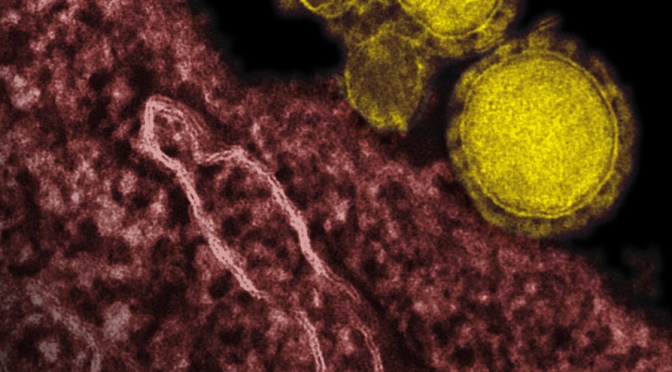
Colorized transmission electron micrograph of the Middle East respiratory syndrome coronavirus (Credit: NIAID via Flickr used under CC license)
In 2002 the first cases of a strange new flu-like illness began appearing in southern China. As case numbers mounted well into 2003, it became clear that this was not the flu. Patients began dying as their lungs filled with fluid and stopped functioning. Researchers rushed to determine what kind of virus was causing this disease before it could spread past hope of containment.
After the hard work of many dedicated individuals, it was determined that this new lethal virus was in fact a coronavirus (later named Sever Acute Respratory Syndrom virus, or SARS-CoV). This was odd, as this kind of virus was not known to cause serious disease in humans before this point. By comparing this new virus to older samples, it was determined that this virus was originally living in bats before jumping to civets, and then finally humans. Thankfully, due to this varied zoonotic background (which means to come from animals), SARS did not have the best person-to-person transmissibility during the early parts of the outbreak and was eventually contained once health care officials new what to look for and quarantine. Once the numbers were tallied it was determined that SARS infected over 8000 people, killing over 700 of the most unfortunate individuals. This would not be the last time a coronaviruses would make a dramatic jump into human hosts. In 2012 we were tested on what we learned during the first SARS outbreak in 2002. Continue reading The decade of the Coronavirus: What SARS and MERS have taught us about containing potential pandemics→






 K.D.Shives