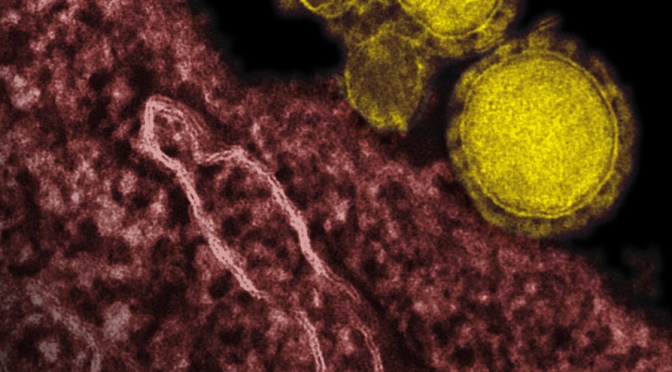
Colorized transmission electron micrograph of the Middle East respiratory syndrome coronavirus (Credit: NIAID via Flickr used under CC license)
In 2002 the first cases of a strange new flu-like illness began appearing in southern China. As case numbers mounted well into 2003, it became clear that this was not the flu. Patients began dying as their lungs filled with fluid and stopped functioning. Researchers rushed to determine what kind of virus was causing this disease before it could spread past hope of containment.
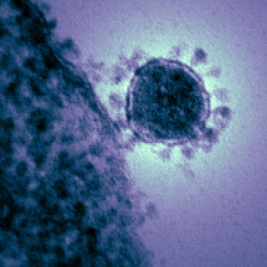
After the hard work of many dedicated individuals, it was determined that this new lethal virus was in fact a coronavirus (later named Sever Acute Respratory Syndrom virus, or SARS-CoV). This was odd, as this kind of virus was not known to cause serious disease in humans before this point. By comparing this new virus to older samples, it was determined that this virus was originally living in bats before jumping to civets, and then finally humans. Thankfully, due to this varied zoonotic background (which means to come from animals), SARS did not have the best person-to-person transmissibility during the early parts of the outbreak and was eventually contained once health care officials new what to look for and quarantine. Once the numbers were tallied it was determined that SARS infected over 8000 people, killing over 700 of the most unfortunate individuals. This would not be the last time a coronaviruses would make a dramatic jump into human hosts. In 2012 we were tested on what we learned during the first SARS outbreak in 2002. Continue reading The decade of the Coronavirus: What SARS and MERS have taught us about containing potential pandemics→
This post originally appeared September 6th, 2013 on Gradhacker.org
There is no escaping the need to eat. Graduate student stipends are notoriously tight though, leaving room for the question, “How do I eat well on a student stipend?”
Have no fear, there is no need to live off of ramen (unless you love it, then by all means go right ahead). As an admitted foodie, I was worried that I would have to revert to my undergrad ways of ramen and bulk off-brand lucky charms after two years working in a paying job and eating vegetables. Once I adjusted to a new city, different food availability, and a new food budget in graduate school I realized that as students we can afford to eat healthy, filling food that tastes good—something I realized AFTER I gained 10 pounds eating numerous pilfered, bland seminar bagels over the course of a semester. All it takes is a willingness to shop in new ways, learn some basic cooking skills, and spend some time in the kitchen. Most importantly, I learned that there are two main actions you can take to get the best food on a student budget: buy smarter and cook at home. Continue reading Eating Well on a Grad Student Stipend→
This article originally appeared on Gradhacker.org on August 9th, 2013.
Many of us in the sciences begin graduate school not only with classes, but with extensive lab rotations that center upon completing bench science as well. This is the real classroom for many scientists-in-training and is an invaluable training experience. However, for some students it can be difficult to be productive during such a short time (some rotations last only a few weeks), so learning good time management skills at the bench will aid you now in your rotations and down the road in your dissertation lab.
I worked on my time management as a research assistant prior to graduate school and still struggled to balance classes and significant hours in the lab. I’ve come to refer to my time management method for lab work as the “Russian nesting doll approach.” These basic principles can be widely applied in a variety of research situations. Continue reading Hacking Time Management for the Bench Scientist→
Colorized Pandoravirus electron microscopy(图) (Photo credit: 禁书网中国禁闻)
This last year has had many important developments in the field of microbiology, but by far one of the most interesting is the publication discovery of the Pandoravirus genus of viruses. Published in the July 19th 2013 issue of Science Magazine, it is undeniably the biggest virus ever discovered; both in terms of its genome (2.5 MILLION base pairs in length) and it’s physical size ( at 1 micrometer in length it can be seen with a LIGHT microscope!).
A glioma, or brain tumor (Photo credit: aktyuvinsk34)
While I’ve written in the past about viruses that can cause cancer, today I want to introduce the concept of using viruses to selectively kill cancer cells. These types of viruses are called oncolytic viruses, meaning that they kill (-lytic) cancer cells (onco-) but not normal healthy cells.
This makes them potentially very powerful tools in treating cancers that don’t respond well to established approaches of chemotherapy, radiation, or surgery. This approach is still in its infancy, but the potential of viral oncology remains promising.
One of the major aspects of academia is sharing your research throughpublic presentations. While public speaking can be stressful, it is a great opportunity to communicate your research and ideas to a wider audience and can be quite satisfying. No matter what kind of subject matter you are covering, there are a few simple hacks that you can use to improve you public speaking abilities. Continue reading Five Quick Tips for More Effective Public Speaking→



 K.D.Shives